Oxford's two rivers - the Cherwell, the Isis and Port Meadow
The Thames changes its name here, and the smaller river is the one people remember.
Oxford's river life centres on two waterways, the Thames, locally called the Isis, and the Cherwell, which meets it near the city centre. This guide covers places members walk, punt, or row past, with character, history, and what to notice.
The Thames in Oxford - Why It Is Called the Isis
The Thames is the Isis in Oxford because the name Isis comes from the Latin Tamesis, the Roman name for the river. In Oxford, the Thames is usually called the Isis, especially on the stretch through the city and downstream towards Abingdon. The name is not a separate river. It is the same Thames, viewed through local habit and older usage. The Isis is narrower and more intimate here than the broad Thames of London. Its banks carry college boathouses, meadows, and paths that make the river feel like part of the city rather than a boundary beyond it.
The River Cherwell and the Cherwell Boathouse
The Cherwell is the quieter of Oxford's two rivers. It curves through the city from the north and joins the Thames near Christ Church Meadow. Its character is gentle, winding, and shaded by trees, with a slower current than the Isis. The Cherwell Boathouse stands on the river at Bardwell Road and has long been associated with punting and small-boat hire. Look for the boathouse's riverside setting, the punts lined along the bank, and the way the river opens into wider reaches as it approaches the Thames. The Cherwell is also the river most visitors associate with punting through Oxford's college backs.
Magdalen Bridge
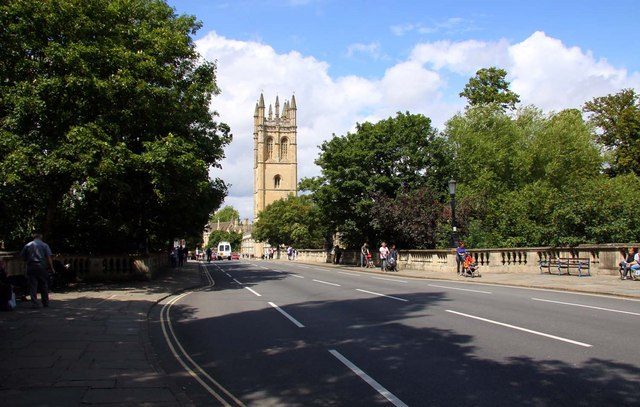
Magdalen Bridge carries High Street over the Cherwell at the eastern edge of the city centre. It is a busy, urban crossing with traffic, pedestrians, and views down to punts below. The bridge is named for Magdalen College, whose grounds lie nearby. Its character is lively and central rather than pastoral. Historically, it has been an important route into Oxford from the east. Look at the stonework, the river beneath, and the transition from city street to college grounds. In May, the bridge is known for the traditional early-morning singing from Magdalen College tower, though the bridge itself remains a working road crossing.
Christ Church Meadow
Christ Church Meadow is the large riverside meadow south of Christ Church. The Thames, or Isis, forms one boundary and the Cherwell another, giving the meadow a triangular shape between the two rivers. Its character is open, green, and surprisingly quiet for a place so close to central Oxford. Historically, it has been used for grazing, walking, and college sport, and it remains one of the city's most valued open spaces. Look for the paths along the rivers, the view towards the city spires, and the way the meadow narrows where the Cherwell meets the Thames.
Folly Bridge
Folly Bridge crosses the Thames, or Isis, south of Christ Church Meadow. It is a stone bridge with a more compact, urban feel than the open meadow nearby. Historically, it has been an important crossing on the southern approach to Oxford. Its character is practical and architectural, with views along the river towards college boathouses and the meadow. Look at the bridge's structure, the water flowing beneath, and the contrast between the busy road above and the calmer river below. From here, the Isis begins to feel less like a city river and more like a route out towards the countryside.
Iffley Lock
Iffley Lock is a Thames lock south of Oxford, reached by riverside paths from the city. It marks a change in the river's character from urban Isis to a more rural waterway. The lock itself is a working structure with gates, chambers, and a towpath. Historically, locks on the Thames managed water levels and allowed boats to pass safely. Look at the lock gates, the difference in water level, and the boats waiting to pass through. The surrounding area is quieter than central Oxford, with trees, meadows, and a slower pace that rewards a longer walk from Folly Bridge.
Port Meadow
Port Meadow is a wide, open riverside meadow on the western side of Oxford, beside the Thames. Its character is expansive, flat, and almost rural, despite being close to the city. Historically, it has been common land, used for grazing and recreation for centuries. Look for the broad river views, grazing animals, and wide skies that make the meadow feel larger than its distance from the centre suggests. It is one of the best places in Oxford to understand how the Thames shaped the city's landscape, because the river, meadow, and distant spires can all be seen together.
What to notice on a member walk
At the Isis, notice college boathouses, meadows, and the way the river feels woven into the city. At the Cherwell, notice punts, tree shade, and the slower current near Bardwell Road. At Magdalen Bridge, notice stonework, punts below, and the shift from street to college grounds. At Christ Church Meadow, notice the triangular shape formed by the Thames and Cherwell. At Folly Bridge, notice the contrast between road traffic and the calmer water below. At Iffley Lock, notice gates, water levels, and boats waiting to pass. At Port Meadow, notice grazing animals, broad river views, and wide skies.
Walking routes and river character
A member can connect several places without a boat. Magdalen Bridge, Christ Church Meadow, Folly Bridge, and Iffley Lock can be linked by riverside paths and city streets, with the river changing from urban crossing to working lock. Port Meadow is better reached from the western side of Oxford, where the Thames feels open and rural. The Cherwell offers a quieter route, especially near the Cherwell Boathouse, while the Isis carries more college rowing activity and a stronger sense of Oxford's river tradition. Matthew Arnold's phrase "city of dreaming spires" captures the view from several of these riverside points, though the rivers themselves are best understood through walking rather than quotation.
Frequently asked questions
Is the Isis a different river from the Thames?
No. The Isis is the local name for the Thames in Oxford. It is the same river, and the name comes from the older Latin form Tamesis rather than from a separate waterway.
Where does the Cherwell meet the Thames?
The Cherwell joins the Thames near Christ Church Meadow, at the southern end of the city centre. This meeting of the two rivers is one of the defining geographical features of Oxford.
Can I walk between these river places without a boat?
Yes. Many of these places are linked by riverside paths and city streets. A walk can connect Magdalen Bridge, Christ Church Meadow, Folly Bridge, and Iffley Lock, while Port Meadow is better reached from the western side of the city.
This is an independent member's guide compiled by Oxford Society. We are not affiliated with the venues and institutions mentioned; opening arrangements and programmes change - always confirm details on the official websites before making plans.
← Back to Guides